

What is Taxonomy?
Taxonomy is a scientific system used for the classification of organisms. The history of taxonomy can be traced back as far as the origin of human language.
We use taxonomy derived from social experience in everyday language to make sense of the world. For example, wild animals, domestic animals, birds, bugs, fish. These are folk taxonomies, classification terms we use that are separate from and more generalized than taxonomic language used in science.
In addition to its application in the natural world, a taxonomic system can be applied to a body of knowledge or practice to create a hierarchical framework and common language.
For example, in meditation research, meditation types have been understood in terms of focused meditation vs. non-focused meditation. In some cases, meditation types based on a spiritual grounding have been studied in contrast with secular meditation.
The Human Instinct to Classify
Evidence of the human instinct to organize and classify dates back to ancient times. As a matter of survival in primitive society, edible and poisonous plants were distinguished by taste and personal experience.
Here are examples of how human’s instinct to classify has helped us make better sense of the world around us.
“Divine Farmer”, Emperor Shen Nong (神农)
Emperor Shen Nong (28th century B.C.) was one of China’s cultural heroes along with The Yellow Emperor and Fu Xi (created of the eight trigrams, the basis of the I Ching, The Book of Changes).
In one of the authoritative texts for Chinese Medicine, Shen Nong Ben Cao (神农本草经), translated as The Herbal Classic of the Divine Farmer, Emperor Nong documented his study of herbs, personally tasting hundreds of herbs to test their healing value. His meticulous documentation of these herbal varieties was in large part the reason herbs became routinely used in China.
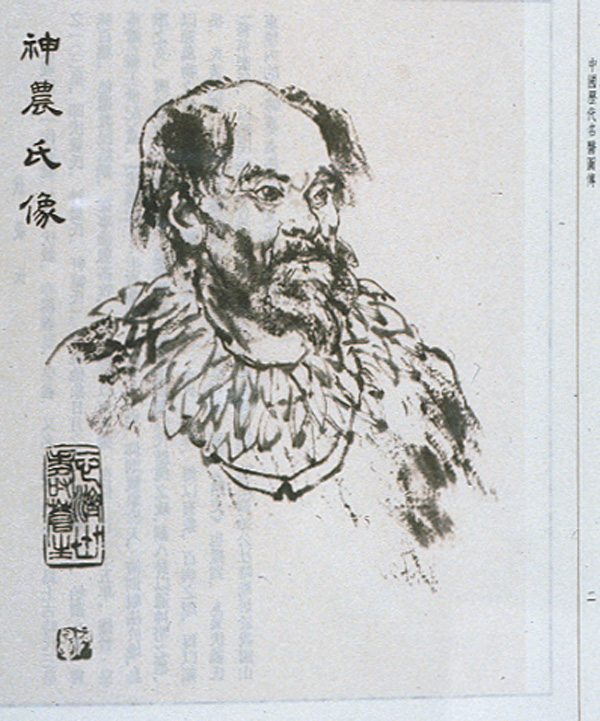
Emperor Shen Nong, Father of Chinese Herbal medicine.
Source: National Library of Medicine
Hsun Tzu (荀況) on the Hierarchy of Classification
In the Confucian doctrine, the Rectification of Names, Chinese philosopher Hsun Tzu (c. 278-238 B.C.) wrote this about the consideration of hierarchy in classification:
“In dealing with the multitude of articles of nature, we may treat them inclusively as a whole and call them organisms. So, organism is a generalized term. Within the organismic world, we can begin with the simple lowermost ranks and group them upwards into higher ones, and stop only when there are no more categories. We may also treat the organisms separately by groups. For example, we may deal only with birds and animals. Even birds and animals are inclusive terms. We can take these and separate them. divide them again and again, until there is no more division to be made”.
Aristotle: With or Without Blood
In Western scientific taxonomy, Greek philosopher Aristotle [384-322 B.C.) classified animals into two categories: with blood and without blood and added a further classification into live-bearing vs. egg-bearing. Carolus Linnaeus would apply the latter classification method some 2,000 years later when formalizing Class Mammalia in the binomial nomenclature system of naming.
Human instinct to classify organisms began as a means of survival and evolved into classification—of everything in the natural world as well as knowledge itself—as a way to process the world at large.
Taxonomy and Art
From ancient China to Egypt to the naturalists of the Enlightenment, living organisms were documented stroke by stroke, painstakingly by hand. It is an effort easily overlooked given nowadays we can accomplish the same task with a fraction of the effort and in the blink of an eye.
Here are some examples of exemplary art that was instrumental to the development of taxonomy.
The Art of Gaspard Bauhin
Swiss anatomist, physician and botanist, Gaspard Bauhin (Casparus Bauhinus) was one of the first to publish a systematic presentation of plants. In Pinax Theatri botanica or The Illustrated Exposition of Plants (1623), Bauhin documents some 6,000 plants, classified by shared characteristics. (Many of these classifications are no longer used; however, one of Bauhin’s legacies is his use of a generic and specific name or names to describe each specimen.)

Pinax Theatri botanica (Page 123). Source: Wikimedia Commons
The Art of Maria Sybilla Merian
German entomologist and naturalist, Maria Sybilla Merian, was the first to illustrate plant-host interactions. For example, her richly illustrated books depicted the life cycles of insects alongside their food sources. Her influence would extend into the world of taxonomy, with certain orders of insects and moths being named for the plants upon which they fed.

Illustration by Maria Sybillia Merian, German entomologist and naturalist. Source: BBVA
The Art of Carl Linnaeus
Carl Linnaeus (Carolus Linnæus) was a 1700s Swedish botanist who is known as the “father of taxonomy” for his meticulous effort in collecting, documenting, illustrating and classifying plants, animals and “minerals”, and formalizing the binomial naming system that is the international naming standard used today.
Linnaeus published his initial findings in a 7 folio book, Systema Naturae, in 1735, complete with three tables of documented organisms. By the time the 12th and final edition was published roughly three decades later, the book included 12,000 plant and animal species.
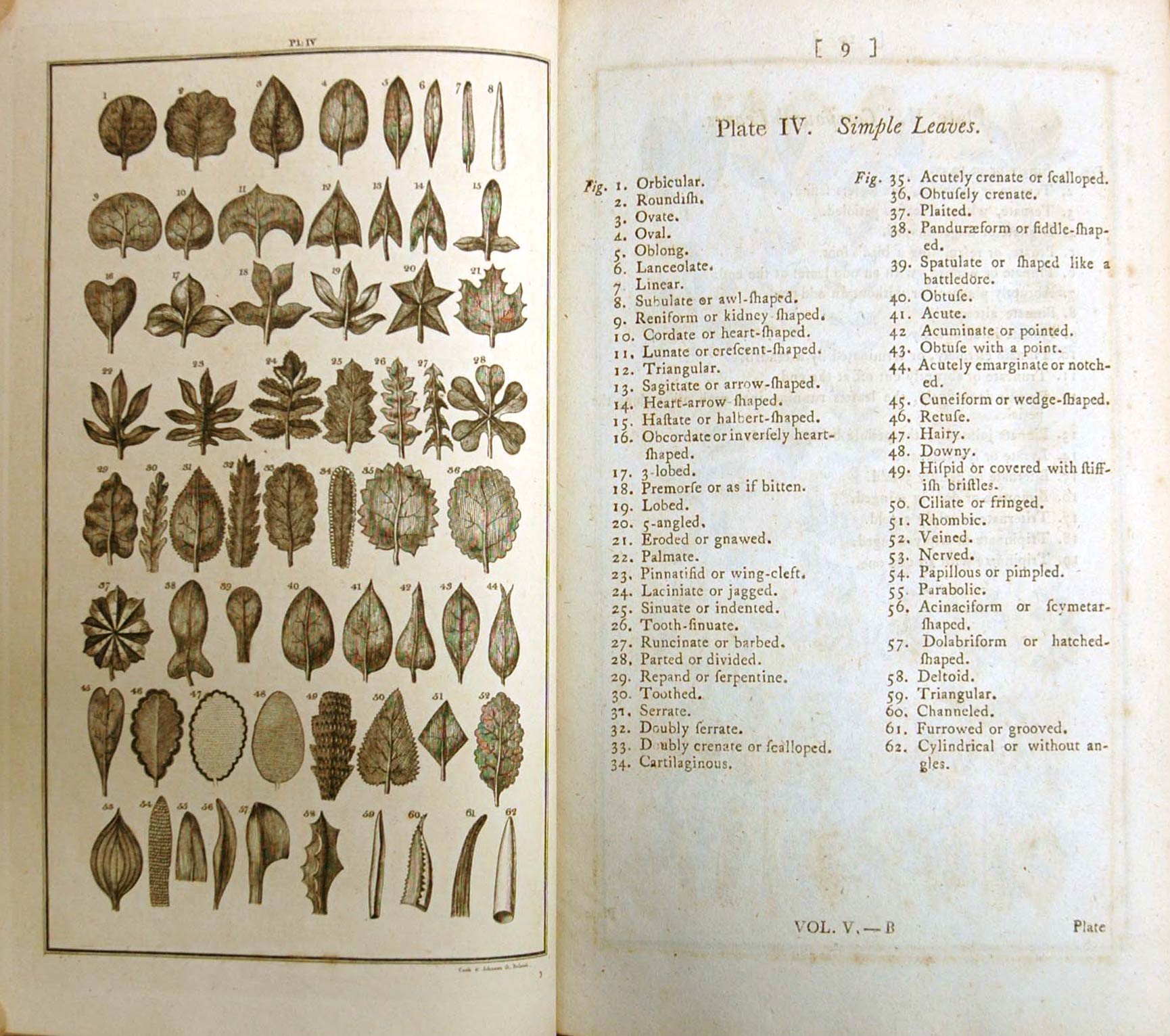
62 types of leaves as depicted in Carolus Linnaeus’ Systema Naturae Source: University of Otago
Challenges of Meditation Research
Meditation encompasses a wide variety of practice types and this has muddied research efforts on meditation.
Folk Taxonomies of Meditation Types
Many folk taxonomies of meditation types are used today and have been the basis of earlier studies on meditation.
For example, meditation types can be viewed as focused meditation or non-focused (open awareness) meditation. An example of focused meditation type is breath meditation, where the sensations of breathing are the focus and where mind-wandering is a tool to trigger the refocusing on the breath.
An example of non-focused meditation is mindfulness meditation which is meant to develop a meta-awareness, an awareness of awareness. Vipassana meditation is one example.
However, in select Buddhist meditation traditions, focused attention precedes non-focused meditation as part of a single practice. Furthermore, focused attention is seen as a “warm-up” to non-focused meditation since it is difficult for a novice meditator to drop into open-awareness meditation without the ability to first focus. If they tried, their untrained mind would instantly be bombarded with thoughts and the opportunity for open-awareness meditation would be difficult to find. Namely, the meditator would not perceive any opening—a moment of stillness—into which open-awareness could enter.
Other examples of meditation type classifications include guided vs. unguided, sitting vs. walking meditation, eyes open vs. eyes closed meditation, and spiritual vs. non-spiritual meditation.
Agreeing Upon Characteristics of Meditation Types to Measure
The number of ways to classify meditation types is infinite.
How do we decide which dimensions or characteristics are important to measure and then unify the measurements of these characteristics across studies?
In other words, there is currently no common language and no universally accepted parameters by which meditation is studied to allow for one study to be meaningfully compared to another.
Vast Array of Meditation Types

Tai chi chuan martial artist, practicing in a park. Photo: Wes Chuan
Finally, our understanding of meditation types lacks attention to the many and varied practices that fall under the definition of meditation.
Looking back, before a unifying taxonomy of organisms was ever created, naturalists around the world started by building a massive “inventory”, collecting and illustrating newly discovered specimens in great detail. Only after collecting a mass amount of data in this way did the similarities and differences and points of import for classification begin to take shape.
The equivalent understanding via an inventory or catalog of meditation types does not exist. Research is undertaken without a thorough understanding of the broader landscape of meditation types. This may result in one set of findings for open awareness meditation in the Tibetan Buddhist tradition and another set of findings as a result of studying Zen Buddhist monks in zazen.
Summary
There is a lot of knowledge to be gained by studying the development of taxonomy in the plant and animal world which began some five millennia ago. It seems we have jumped into the world of meditation research while skipping some important steps, namely:
- Answer the question, What is meditation?
- Taking an inventory of practices within this definition of meditation types
- Understanding how these practices overlap and how they differ
In other words, before a taxonomy of meditation types can be seriously contemplated, it is worthwhile to start developing a comprehensive catalog of meditation types with descriptions of practice methods, goals and history. This would provide a more solid grounding for future meditation research and might retroactively give new meaning to historical research.